Not long ago, students relied on search engines, textbooks, and endless hours of note-taking to keep up with their studies. Fast forward to 2026, and the academic landscape looks very different. Artificial intelligence has become a practical companion for students, helping them learn faster, stay organized, and manage increasingly demanding workloads.
The best part is that AI isn’t just for tech-savvy students. Whether you’re studying medicine, engineering, business, law, or the humanities, there are AI tools designed to make your academic life easier.
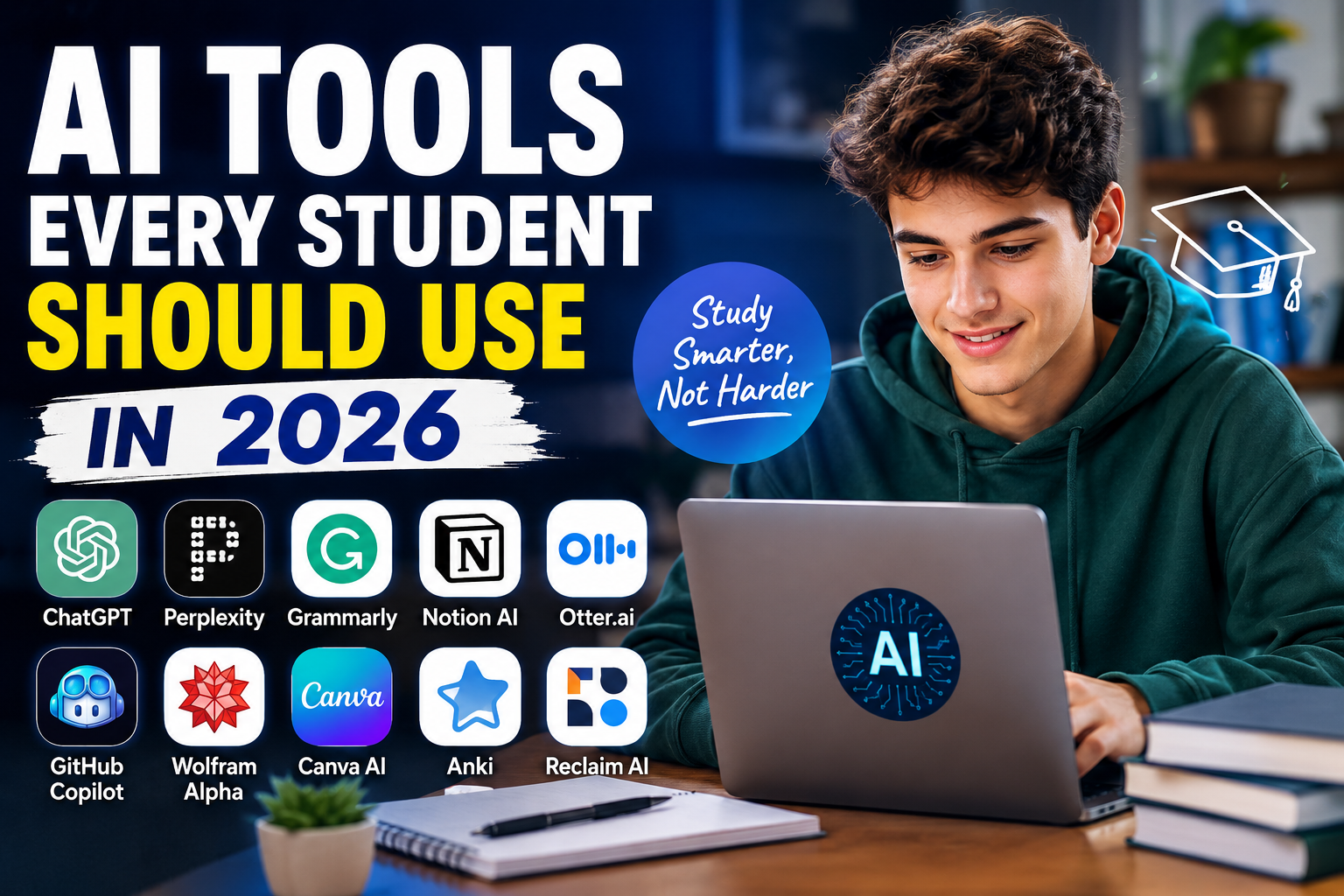
Here are the AI tools that are making the biggest impact on student success in 2026.
ChatGPT: The Digital Tutor That’s Always Available
Every student has faced a moment when a lesson simply doesn’t click. Maybe it’s a confusing math problem, a difficult theory, or a topic that your professor explained too quickly.
This is where ChatGPT has become a game-changer.
Instead of spending hours searching for explanations, students can ask questions in plain language and receive clear, personalized responses instantly. It can simplify difficult concepts, create revision notes, generate quizzes, and even help students understand feedback from teachers.
Many students now use ChatGPT as a first stop when they’re stuck on an assignment or preparing for an exam. While it shouldn’t replace genuine learning, it can make the learning process far more efficient.
Perplexity: A Smarter Way to Research
Research often involves opening dozens of browser tabs and sorting through information from different sources. Perplexity simplifies that experience by combining AI-powered answers with direct references.
Students can quickly explore topics, compare viewpoints, and locate reliable information without wasting time jumping between websites.
For anyone writing essays, reports, or dissertations, this tool can dramatically speed up the research process while encouraging proper fact-checking and source verification.
Grammarly: Your Writing Safety Net
Good ideas lose their impact when they are poorly communicated. That’s why strong writing remains one of the most important skills a student can develop.
Grammarly acts as a second pair of eyes, helping students identify grammatical mistakes, improve sentence structure, and communicate ideas more clearly.
Beyond simple corrections, it helps improve tone, readability, and overall writing quality. Whether you’re preparing an academic paper or a scholarship application, Grammarly helps ensure your work looks polished and professional.
Notion AI: The Ultimate Student Workspace
One of the biggest challenges students face isn’t studying—it’s staying organized.
Assignments, lecture notes, project deadlines, and exam schedules can quickly become overwhelming. Notion AI helps bring everything together in one place.
Students can create study plans, organize notes, manage tasks, and even use AI-powered features to summarize information and generate outlines.
Instead of relying on multiple apps, many students now use Notion as their central hub for academic life.
Otter.ai: Never Miss a Lecture Again
Trying to listen, understand, and take notes at the same time can be frustrating. Important details often get lost in the process.
Otter.ai solves this problem by automatically recording and transcribing lectures and discussions. Students can revisit important points later and focus more on understanding the material during class.
For university students attending lengthy lectures or online classes, this tool can significantly improve note quality and information retention.
GitHub Copilot: The Coding Assistant Every Developer Wants
Learning to code involves trial and error, and sometimes a lot of frustration.
GitHub Copilot helps students navigate that process by offering real-time coding suggestions and explanations. It can recommend solutions, complete repetitive code, and help students understand unfamiliar programming concepts.
While it shouldn’t replace hands-on learning, it serves as an excellent companion for aspiring developers who want to improve their coding skills more efficiently.
Wolfram Alpha: The Problem-Solving Powerhouse
Students in mathematics, engineering, and science often deal with complex calculations that require more than a standard calculator.
Wolfram Alpha provides detailed solutions and step-by-step explanations for a wide range of academic problems. Instead of simply giving an answer, it helps students understand the logic behind the solution.
That makes it particularly valuable for learning difficult concepts rather than merely completing homework.
Canva AI: Making Presentations Look Professional
In today’s classrooms, presentation skills matter almost as much as subject knowledge.
Whether you’re creating slides for a group project or designing a research poster, Canva AI makes the process faster and easier. Students can generate layouts, visuals, and designs with minimal effort while maintaining a professional appearance.
Even those with no design experience can create presentations that capture attention and communicate ideas effectively.
Anki: The Secret Weapon for Long-Term Memory
Cramming might help before a test, but it rarely leads to long-term retention.
Anki takes a different approach by using spaced repetition, a learning technique designed to help students remember information over extended periods. The system schedules reviews based on what you’ve already mastered and what still needs practice.
This method is especially popular among medical, law, and language students who need to memorize large volumes of information.
Reclaim AI: A Personal Time Manager
Most students know what they need to do—they just struggle to find time to do it.
Reclaim AI helps solve this problem by automatically scheduling study sessions, organizing tasks, and protecting time for important priorities.
Instead of constantly adjusting calendars and to-do lists, students can focus on completing their work while the AI manages their schedule behind the scenes.
The Real Advantage of AI in Education
The conversation around AI often focuses on whether students should use it. The more important question is how they should use it.
The most successful students in 2026 are not using AI to avoid learning. They are using it to learn more effectively. They use AI to understand difficult topics, improve productivity, organize information, and spend more time thinking critically.
Artificial intelligence cannot replace curiosity, creativity, or genuine understanding. What it can do is remove many of the barriers that make learning more difficult than it needs to be.
As education continues to evolve, AI tools are becoming as essential as laptops, search engines, and online libraries. Students who learn to use them wisely will not only perform better academically but will also be better prepared for a future where AI is part of everyday work and life.
