Introduction
Artificial Intelligence (AI) and Machine Learning (ML) are terms that dominate conversations about modern technology. From smart assistants that answer our questions to recommendation systems that seem to know exactly what we want to watch next, these technologies have become part of everyday life.
Yet, despite their widespread use, there is still a lot of confusion about what AI and Machine Learning actually mean. Many people assume they are interchangeable terms, but that’s not entirely accurate. While Machine Learning is closely connected to Artificial Intelligence, it represents only one part of a much larger picture.
If you’ve ever wondered how AI differs from Machine Learning, this guide will help you understand the relationship between the two and why the distinction matters.
Artificial Intelligence: The Bigger Vision
Artificial Intelligence is the concept of creating machines that can perform tasks that would normally require human intelligence. These tasks can include understanding language, recognizing images, making decisions, solving problems, and even learning from experience.
The idea behind AI is not necessarily to replicate the human brain perfectly but to create systems capable of acting intelligently in specific situations.
Consider a navigation app that suggests the fastest route home during rush hour. It analyzes traffic conditions, predicts delays, and recommends an alternative path. This ability to process information and make decisions is an example of artificial intelligence at work.
AI is a broad field that combines computer science, mathematics, psychology, and data analysis to create smarter systems.
Machine Learning: Teaching Computers Through Data
Machine Learning is one of the most important technologies that powers modern AI systems.
Instead of programming a computer with every possible rule, Machine Learning allows it to learn from examples. The system examines large amounts of data, discovers patterns, and uses those patterns to make predictions or decisions.
For example, when a music streaming service recommends songs based on your listening habits, it is using Machine Learning algorithms to understand your preferences.
The key idea behind Machine Learning is simple: the more relevant data a system receives, the better it becomes at performing its task.
How AI and Machine Learning Work Together
One of the easiest ways to understand the relationship is to think of AI as the destination and Machine Learning as one of the vehicles used to get there.
Artificial Intelligence represents the goal of creating intelligent machines. Machine Learning provides a practical method for achieving that goal by enabling systems to learn from data rather than relying solely on fixed instructions.
Before Machine Learning became widely available, many AI systems relied heavily on manually created rules. Today, Machine Learning has become one of the most effective approaches for building intelligent applications because it allows systems to adapt and improve automatically.
The Key Differences Between AI and Machine Learning
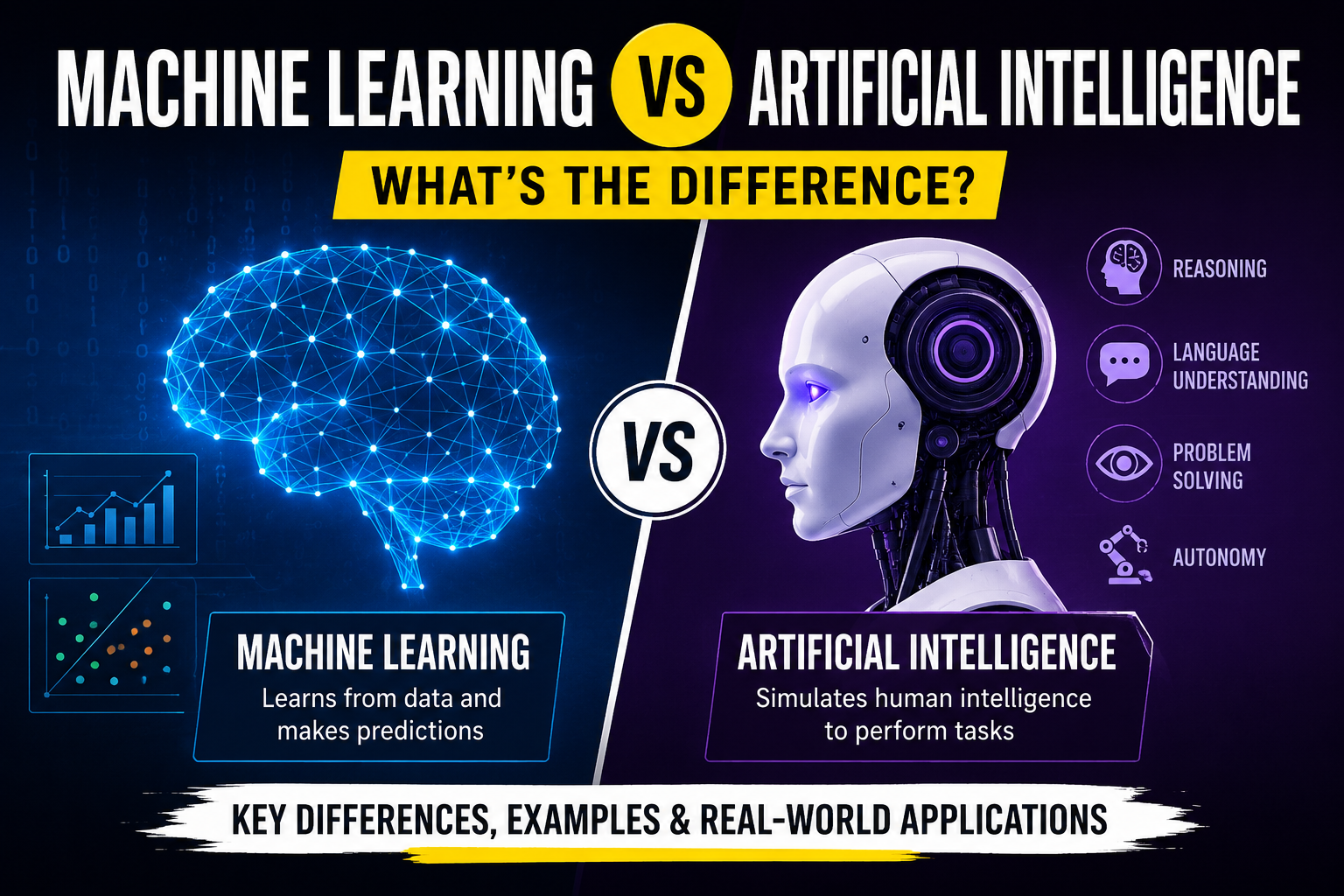
Although they often overlap, AI and ML serve different purposes.
Scope
Artificial Intelligence is an umbrella term that covers many technologies, including Machine Learning, robotics, expert systems, computer vision, and natural language processing.
Machine Learning is a specific branch within AI focused on learning from data.
Objective
The goal of AI is to create machines capable of performing intelligent actions.
The goal of Machine Learning is to develop algorithms that improve their performance through experience and data.
Approach
AI may use predefined rules, logical reasoning, or learning mechanisms to solve problems.
Machine Learning relies primarily on data and statistical techniques to identify patterns and make predictions.
Adaptability
Traditional AI systems may follow fixed instructions.
Machine Learning systems can continuously improve when exposed to new information.
Data Usage
AI can sometimes function without large datasets.
Machine Learning depends heavily on data for training and improvement.
Examples of Artificial Intelligence in Daily Life
Many people interact with AI every day without realizing it.
Some common examples include:
- Virtual assistants that respond to voice commands
- Smart home devices that automate household tasks
- Customer service chatbots
- Language translation applications
- Self-driving vehicle technologies
- Facial recognition systems
These applications use AI to interpret information and make decisions that help users complete tasks more efficiently.
Examples of Machine Learning in Action
Machine Learning often works behind the scenes, analyzing data and generating insights.
Popular examples include:
- Email spam filters
- Product recommendation systems
- Fraud detection in banking
- Personalized advertisements
- Social media content recommendations
- Predictive text and autocorrect features
In each case, the system learns from previous interactions and becomes more accurate over time.
Why Machine Learning Has Become So Important
Machine Learning has gained tremendous popularity because modern organizations generate enormous amounts of data.
Manually analyzing that data would be slow, expensive, and often impossible. Machine Learning allows businesses to process information at scale and uncover patterns that humans might never notice.
For example, hospitals can use Machine Learning to identify disease risks earlier, while retailers can predict customer demand and optimize inventory levels.
The ability to transform raw data into actionable insights is one of the biggest reasons why ML has become a cornerstone of modern innovation.
Benefits of Artificial Intelligence
Artificial Intelligence offers several advantages that make it valuable across industries.
Improved Efficiency
AI can automate repetitive tasks and free employees to focus on more strategic work.
Faster Decision-Making
AI systems can process vast amounts of information in seconds and provide recommendations almost instantly.
Better Customer Experiences
Businesses use AI to personalize interactions and provide support around the clock.
Increased Accuracy
AI reduces the likelihood of human errors in areas such as manufacturing, healthcare, and financial analysis.
Benefits of Machine Learning
Machine Learning brings additional advantages, particularly in data-driven environments.
Continuous Improvement
ML systems become more accurate as they learn from new data.
Predictive Capabilities
Organizations can forecast trends and anticipate future outcomes more effectively.
Pattern Recognition
Machine Learning excels at identifying relationships and anomalies that might be difficult for humans to detect.
Scalability
ML models can analyze millions of records quickly, making them ideal for large-scale operations.
Challenges Facing AI and Machine Learning
Despite their impressive capabilities, these technologies are not without limitations.
One major challenge is data quality. A Machine Learning model trained on incomplete or biased data may produce inaccurate results.
Privacy is another concern. As organizations collect more data, ensuring that personal information is handled responsibly becomes increasingly important.
There are also ethical questions surrounding transparency and accountability. When an AI system makes an important decision, users often want to know how that decision was reached.
Addressing these concerns will be essential as AI and ML continue to expand into more aspects of society.
The Future of Intelligent Technology
Artificial Intelligence and Machine Learning are evolving at an extraordinary pace. Innovations that once seemed futuristic are becoming reality.
In the coming years, we are likely to see:
- More advanced virtual assistants
- Smarter healthcare diagnostics
- Greater automation in transportation
- Improved cybersecurity systems
- Highly personalized digital experiences
- More powerful generative AI applications
As technology advances, AI and ML will continue to influence how businesses operate and how people interact with the digital world.
Conclusion
Artificial Intelligence and Machine Learning are closely connected, but they are not the same thing. Artificial Intelligence is the broader field focused on creating systems that can perform tasks requiring human-like intelligence. Machine Learning is a subset of AI that enables machines to learn from data and improve without being explicitly programmed for every scenario.
A simple way to remember the difference is this: Artificial Intelligence is the overall ambition of building intelligent machines, while Machine Learning is one of the most effective techniques used to make that ambition a reality.
Together, these technologies are transforming industries, creating new opportunities, and reshaping the future of innovation.
