Introduction
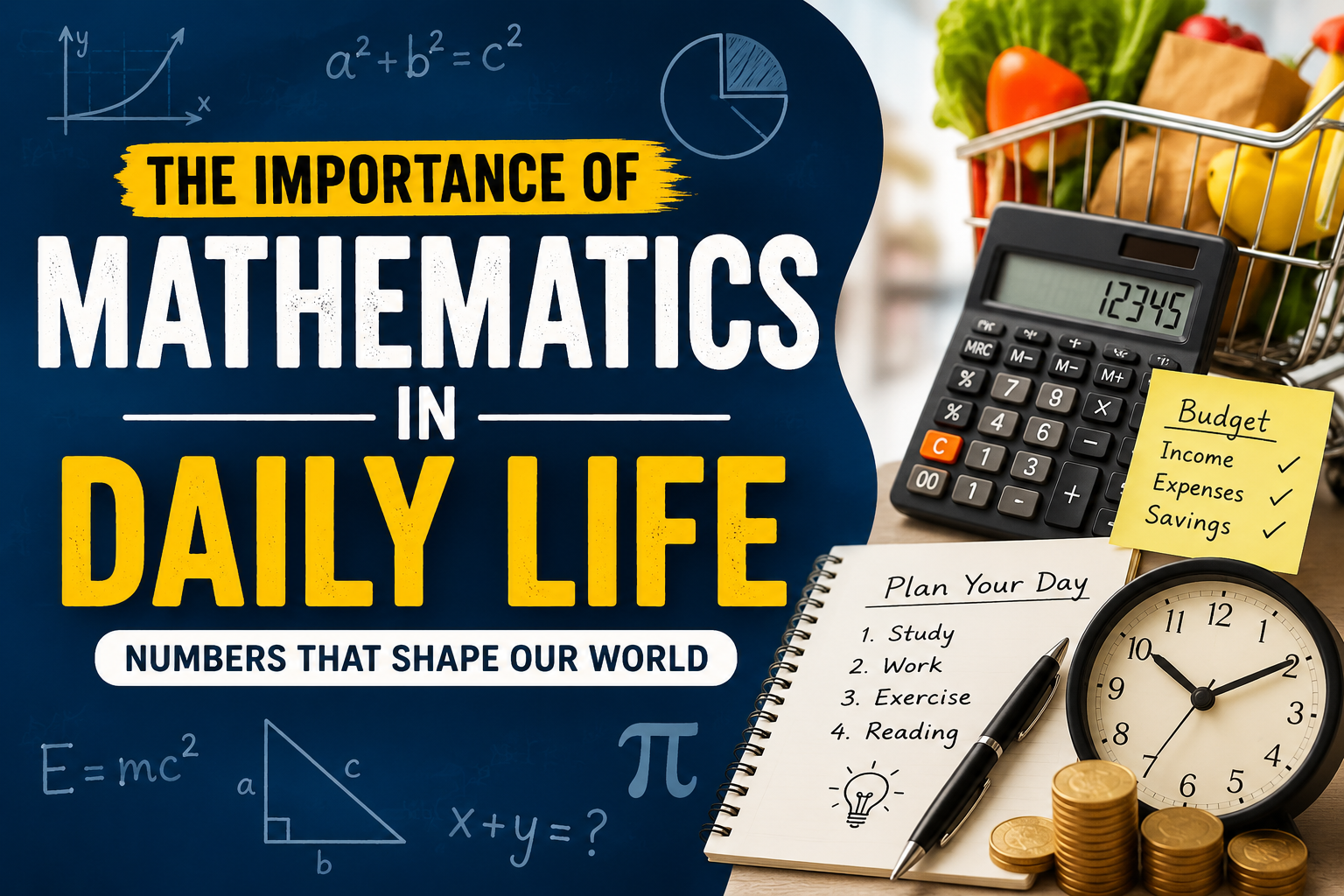
When people hear the word “mathematics,” they often think of difficult equations, lengthy calculations, and classroom assignments. However, mathematics is much more than an academic subject. It is a practical skill that helps us navigate everyday life. Whether we are managing our expenses, planning our schedule, shopping for necessities, or using technology, mathematics quietly supports many of our daily activities. Its importance extends beyond numbers, helping us think logically and make better decisions.
Mathematics Is All Around Us
Most of us use mathematics from the moment we start our day. We calculate how much time we have before leaving for work or school, estimate travel times, and organize our daily tasks. At the grocery store, we compare prices and determine whether a discount is worth taking advantage of. At home, we measure ingredients while cooking and track household expenses.
These activities may seem simple, but they all involve mathematical thinking. Without basic mathematical skills, many routine tasks would become confusing and time-consuming.
Helping Us Make Smart Financial Decisions
Money management is one of the areas where mathematics proves most valuable. Every person, regardless of their profession, needs to understand how to budget and spend wisely. Mathematics allows us to calculate our income, monitor our expenses, and plan for future financial goals.
It also helps us understand concepts such as interest rates, taxes, and savings. When purchasing a product, people often compare prices and evaluate different options before making a decision. Mathematics provides the tools needed to make these choices confidently and responsibly.
The Foundation of Modern Technology
The digital world that surrounds us is built on mathematics. Every smartphone, computer, and online platform relies on mathematical principles to function effectively. From sending a text message to using navigation apps, mathematics works behind the scenes to process information and deliver results instantly.
Many technological innovations, including artificial intelligence, robotics, and data science, would not exist without mathematical knowledge. As technology continues to advance, the role of mathematics becomes even more significant.
Developing Critical Thinking Skills
One of the greatest benefits of learning mathematics is the development of logical reasoning. Mathematics teaches people how to analyze information, recognize patterns, and solve problems step by step. These abilities are useful not only in academic settings but also in everyday situations.
Life often presents challenges that require careful thinking and informed decisions. Mathematical reasoning encourages a structured approach to problem-solving, helping individuals reach effective solutions rather than relying on guesswork.
Mathematics in Professional Life
Almost every career involves mathematics in some form. Engineers use it to design structures, doctors use it to calculate treatments, and business professionals rely on it to analyze financial performance. Scientists use mathematical models to understand complex phenomena, while architects apply mathematical concepts to create safe and functional designs.
Even occupations that do not involve advanced calculations benefit from mathematical thinking because accuracy, analysis, and logical decision-making are valuable in every field.
Mathematics and Everyday Planning
Planning is another area where mathematics plays a major role. Whether organizing a family event, preparing a monthly budget, or planning a journey, mathematical calculations help us estimate costs, allocate resources, and manage time effectively.
For example, when traveling, we calculate distances, fuel expenses, accommodation costs, and travel duration. Such planning reduces uncertainty and helps ensure that things run smoothly.
Conclusion
Mathematics is an essential life skill that influences countless aspects of our daily lives. It helps us manage our finances, use modern technology, solve problems, and make informed decisions. More importantly, it strengthens our ability to think logically and approach challenges with confidence. Rather than being limited to textbooks and classrooms, mathematics serves as a valuable companion in everyday life, making our tasks easier and our decisions wiser. Its importance will continue to grow as the world becomes increasingly dependent on technology and data-driven solutions.
