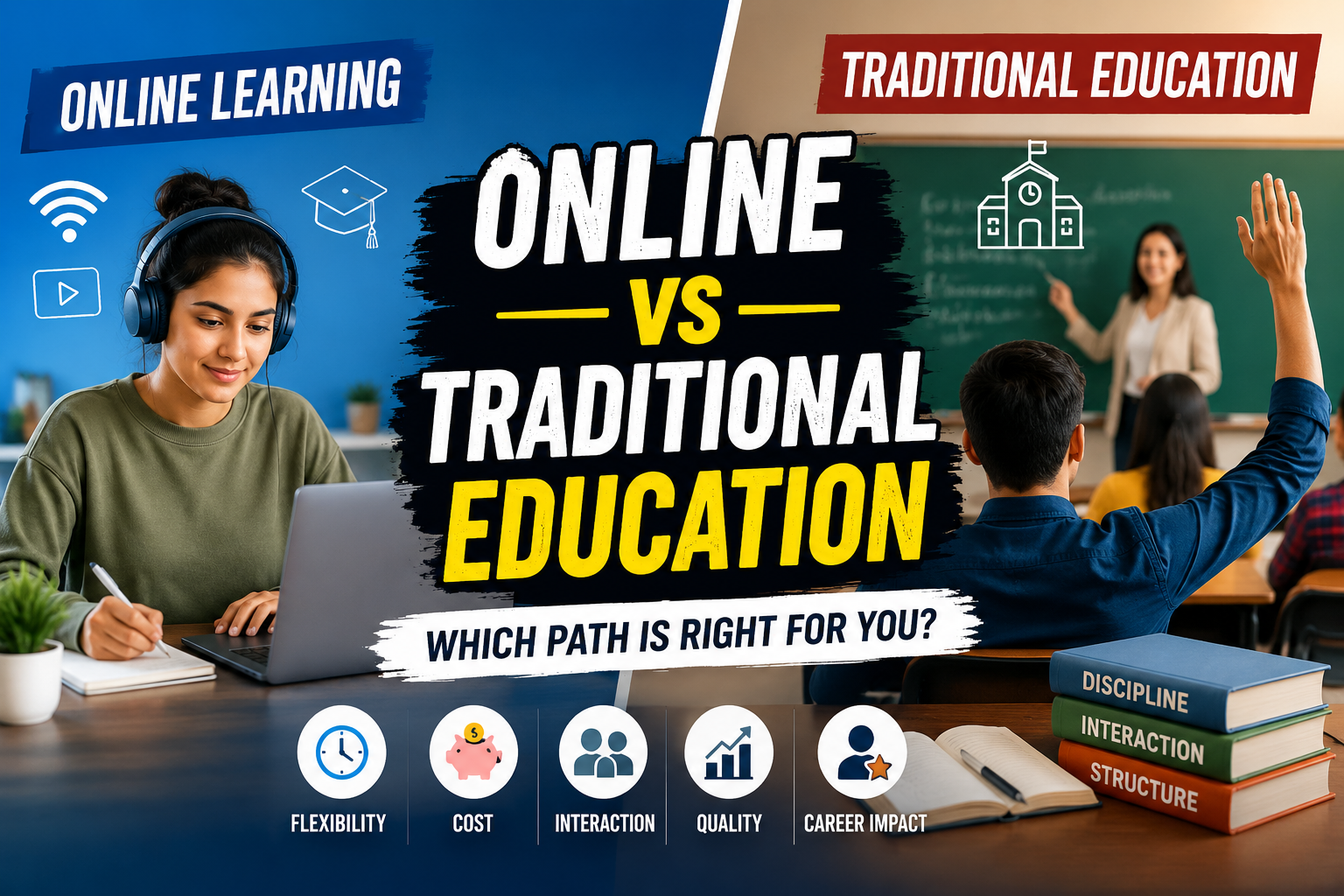
Education has always adapted to the world around it. What used to happen only inside classrooms can now happen on a phone or laptop from almost anywhere. Because of this shift, one question keeps coming up: should we rely on online learning, or does traditional education still matter more?
Instead of treating one as a replacement for the other, it helps to look at how both actually feel in real life—and how they shape different kinds of learners.
Traditional Education: Learning in a Real-World Setting
Traditional education is the system most people grow up with. You go to a school or college, sit in a classroom, follow a timetable, and learn directly from teachers. It’s a structured environment where everything is planned in advance.
But it’s more than just studying. It’s also about the daily experience—meeting classmates, sharing notes, working in groups, and learning how to interact in a social setting.
What makes it valuable
The biggest strength of traditional education is its sense of routine. You don’t have to constantly think about what to study next or when to study—it’s already organized for you. That structure helps many students stay focused and consistent.
It also naturally builds communication skills. Whether it’s asking a question in class or working on a group project, students learn how to express themselves and cooperate with others.
Where it can feel restrictive
However, this system doesn’t always fit everyone perfectly. Students are often expected to move at the same pace, even though learning speed varies from person to person.
It can also be costly and less flexible. Once you’re enrolled, your schedule is mostly fixed, leaving little room for personal adjustments or unexpected changes in life.
Online Learning: Education Without Boundaries
Online learning takes a completely different approach. Instead of going to a physical place, you access lessons through the internet. It could be recorded videos, live classes, or interactive modules—all available on demand.
This creates a learning experience that fits around your life rather than the other way around.
Why many people prefer it
Flexibility is the main reason online learning has grown so quickly. You can study whenever it suits you—early morning, late night, or even during a break at work.
It also makes education more accessible. People who live far from cities or cannot attend physical institutions still have the chance to learn the same subjects as others around the world.
Another benefit is control. If something is difficult, you can pause a lesson, replay it, or take extra time without pressure.
The challenges behind the convenience
But this freedom comes with responsibility. Without a fixed schedule or in-person supervision, it’s easy to delay learning or lose consistency.
There’s also less natural interaction. Even though online tools allow communication, it doesn’t fully replace the feeling of sitting in a room with others and having real-time discussions.
Two Different Ways of Learning
At the heart of the difference is control vs structure.
Traditional education gives structure. Someone else organizes your learning journey and keeps you on track. This works well for students who prefer guidance and routine.
Online learning gives control. You decide how fast or slow you go, and when you study. This suits learners who are independent and self-driven.
Neither approach is automatically better—it depends on the person.
Cost and Accessibility
Traditional education often comes with higher overall costs. Tuition fees, transportation, uniforms, and accommodation can all add up. It also requires physical presence, which may not be possible for everyone.
Online learning usually reduces many of these expenses. With just a device and internet access, learning becomes possible from almost anywhere. However, it still depends on technology, which is not equally available to all.
Interaction and Human Connection
One thing traditional education does very well is human interaction. You meet people every day, talk face-to-face, and build relationships naturally. These small daily experiences play a big role in personal development.
Online learning tries to recreate this through chats, video calls, and forums, but the experience feels more planned and less spontaneous.
Quality of Learning
Quality depends more on the source than the format.
Traditional education is usually standardized, which helps maintain consistency and credibility. It is especially important for subjects that require hands-on practice, like science, engineering, or medicine.
Online learning varies widely. Some courses are created by top universities and experts, while others may not be as reliable. This makes choosing the right platform very important.
Which One Fits Better?
There is no single answer that works for everyone.
Traditional education suits people who prefer structure, direct interaction, and a guided environment. Online learning suits those who want flexibility, independence, and the ability to learn at their own pace.
For many learners today, the most practical solution is a combination of both—using classroom education for structure and online resources for extra support and skill development.
Final Thoughts
Online learning and traditional education are not opposites competing for replacement. They are simply two different ways of learning.
One is built on structure and human presence, while the other is built on flexibility and accessibility. As education continues to evolve, both approaches are likely to exist side by side, giving learners more choice in how they grow and succeed.
Education has always adapted to the world around it. What used to happen only inside classrooms can now happen on a phone or laptop from almost anywhere. Because of this shift, one question keeps coming up: should we rely on online learning, or does traditional education still matter more?
Instead of treating one as a replacement for the other, it helps to look at how both actually feel in real life—and how they shape different kinds of learners.
Traditional Education: Learning in a Real-World Setting
Traditional education is the system most people grow up with. You go to a school or college, sit in a classroom, follow a timetable, and learn directly from teachers. It’s a structured environment where everything is planned in advance.
But it’s more than just studying. It’s also about the daily experience—meeting classmates, sharing notes, working in groups, and learning how to interact in a social setting.
What makes it valuable
The biggest strength of traditional education is its sense of routine. You don’t have to constantly think about what to study next or when to study—it’s already organized for you. That structure helps many students stay focused and consistent.
It also naturally builds communication skills. Whether it’s asking a question in class or working on a group project, students learn how to express themselves and cooperate with others.
Where it can feel restrictive
However, this system doesn’t always fit everyone perfectly. Students are often expected to move at the same pace, even though learning speed varies from person to person.
It can also be costly and less flexible. Once you’re enrolled, your schedule is mostly fixed, leaving little room for personal adjustments or unexpected changes in life.
Online Learning: Education Without Boundaries
Online learning takes a completely different approach. Instead of going to a physical place, you access lessons through the internet. It could be recorded videos, live classes, or interactive modules—all available on demand.
This creates a learning experience that fits around your life rather than the other way around.
Why many people prefer it
Flexibility is the main reason online learning has grown so quickly. You can study whenever it suits you—early morning, late night, or even during a break at work.
It also makes education more accessible. People who live far from cities or cannot attend physical institutions still have the chance to learn the same subjects as others around the world.
Another benefit is control. If something is difficult, you can pause a lesson, replay it, or take extra time without pressure.
The challenges behind the convenience
But this freedom comes with responsibility. Without a fixed schedule or in-person supervision, it’s easy to delay learning or lose consistency.
There’s also less natural interaction. Even though online tools allow communication, it doesn’t fully replace the feeling of sitting in a room with others and having real-time discussions.
Two Different Ways of Learning
At the heart of the difference is control vs structure.
Traditional education gives structure. Someone else organizes your learning journey and keeps you on track. This works well for students who prefer guidance and routine.
Online learning gives control. You decide how fast or slow you go, and when you study. This suits learners who are independent and self-driven.
Neither approach is automatically better—it depends on the person.
Cost and Accessibility
Traditional education often comes with higher overall costs. Tuition fees, transportation, uniforms, and accommodation can all add up. It also requires physical presence, which may not be possible for everyone.
Online learning usually reduces many of these expenses. With just a device and internet access, learning becomes possible from almost anywhere. However, it still depends on technology, which is not equally available to all.
Interaction and Human Connection
One thing traditional education does very well is human interaction. You meet people every day, talk face-to-face, and build relationships naturally. These small daily experiences play a big role in personal development.
Online learning tries to recreate this through chats, video calls, and forums, but the experience feels more planned and less spontaneous.
Quality of Learning
Quality depends more on the source than the format.
Traditional education is usually standardized, which helps maintain consistency and credibility. It is especially important for subjects that require hands-on practice, like science, engineering, or medicine.
Online learning varies widely. Some courses are created by top universities and experts, while others may not be as reliable. This makes choosing the right platform very important.
Which One Fits Better?
There is no single answer that works for everyone.
Traditional education suits people who prefer structure, direct interaction, and a guided environment. Online learning suits those who want flexibility, independence, and the ability to learn at their own pace.
For many learners today, the most practical solution is a combination of both—using classroom education for structure and online resources for extra support and skill development.
Final Thoughts
Online learning and traditional education are not opposites competing for replacement. They are simply two different ways of learning.
One is built on structure and human presence, while the other is built on flexibility and accessibility. As education continues to evolve, both approaches are likely to exist side by side, giving learners more choice in how they grow and succeed.
